Guiding Principles
Our Mission
Hope Parish Liverpool sees a future where a collective of Church of England churches in Toxteth, Wavertree, and the Dingle pursue a mission to introduce people to Jesus, deepen discipleship, develop leaders, and work for justice.
We chose the name Hope Parish Liverpool as it conveys positivity and renewal, resonating with Liverpool’s history of resilience. Hope, a central tenet of our Christian faith anchors our commitment of the Great Commission to share the good news of Jesus Christ (Matthew 28:16-20) and the Great Commandment to show love to our neighbours (Matthew 22:39).
Hope Parish Liverpool will nurture a diverse range of theological, ecclesiological, liturgical, and missional practices, uniting clergy and lay leaders in service to God and the community. Through collaboration, we will build a stronger, more connected parish that actively engages with local needs.
Our Missional Priorities
On September 8, representatives from our churches gathered for a Mission Workshop led by Kate Eaglestone, Cultivate Coach. Discussions centred on how we will work together to fulfil our mission. Following this, our Navigation Team, Growth Team (Mission), and Clergy Leadership Team reviewed the insights and identified key missional priorities to be explored and implemented.
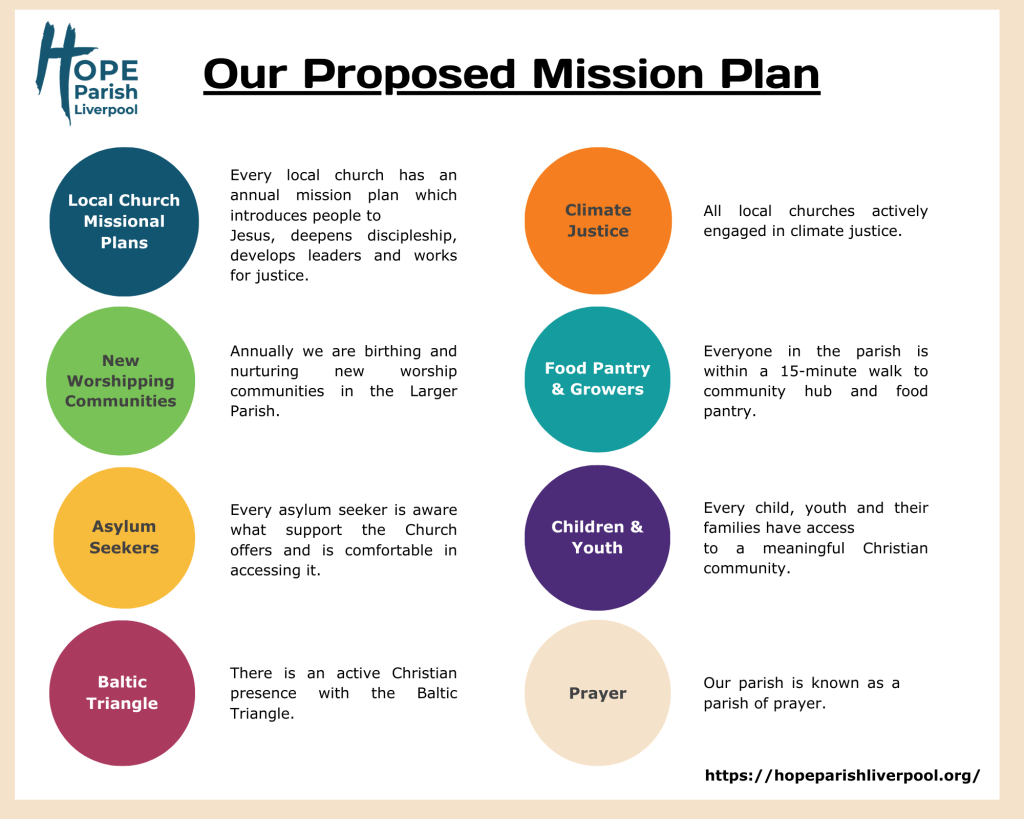
- Local Church Mission Plans: Every local church has an annual mission plan which introduces people to Jesus, deepens disciples, develops leaders and works for justice.
- New Worshipping Communities: Annually we are birthing and nurturing new worship communities in the Larger Parish.
- Children & Youth: Every child, youth and their families have access to a meaningful Christian community.
- Food Pantry & Growers: Everyone in the parish is within a 15-minute walk to a community hub and food pantry.
- Climate Justice: All local churches are actively engaged in climate justice.
- Asylum Seekers: Every asylum seeker knows the support we offer and are comfortable accessing it from our community hubs.
- Baltic Triangle: There is an active Christian presence within the Baltic Triangle.
- Prayer: Our parish is known as a parish of prayer.
Looking Forward
As Hope Parish Liverpool moves into the future, we will remain steadfast in our commitment to unity, faith, and service. Through collaboration, innovation, and unwavering dedication, we will create a thriving, inclusive parish that reflects the love and hope of Christ. We invite all who share this vision to join us in shaping a future where every individual experiences the transformative power of faith in community.
FAQs
In March 2024, local church PCCs who decided to engage in the Fit for Mission journey submitted key questions to be answered. Below you will find a summary of the questions and answers. Should you like to explore additional information you may access the FFM FAQ with over 200 responses or send an email to info@hopeparishliverpool.org.
Q: Is Fit for Mission Diocese or Deanery led? How much flexibility is there at local level to shape this?
A: Absolutely locally led. There are certain parameters – for example it has to be about the 4 priorities of introducing people to Jesus, deepening discipleship, developing Christian leaders and working for justice, and there has to be a commitment to working together in larger parishes. But how all this is done, what detailed choices are made and what this means on the ground is absolutely a local decision. The diocese has provided a framework which will enable a significant step change to take place; it has done a lot of thinking and has prepared and sought resources to make the step change possible. But the details are decided locally.
Q: Will one church be a lead church?
A: Possibly. It depends on the nature of the parish and the definition of church. Some larger parishes may opt for what is sometimes called a minster model where one or two worshipping communities consciously seek to resource and develop others. But this will not be feasible everywhere either because such worshipping communities don’t exist or it is not appropriate. Whatever the situation a ‘lead’ church or worshipping community can never be a controlling or a dominant one. That is not how Fit for Mission works. FfM is about the whole of the body of Christ working together.
Q: What about evangelism in FfM?
A: How we introduce people to Jesus is a major feature of FfM. We won’t be able to plant new worshipping communities and justice initiatives without an absolute commitment to witness and evangelism; it is a thread through everything. There will be portfolio holders in each larger parish with a responsibility for nurturing and encouraging evangelism across the parish; Directions will also be a key resource. But it is all part of the culture change anticipated in FfM.
Q: What does ‘Justice’ mean in FfM?
A: There are certain things that we take as given in our understanding of church and our priorities. So, for example, prayer is not mentioned as one of our four priorities; but we know and assume that everyone knows that FfM absolutely has to be rooted in prayer. Similarly, the whole of the Christian life is about community – the community of the church and the communities in which we find ourselves. So, we take community as a
given. We understand justice in the Micah context of acting justly, loving mercy and walking humbly with God. So, our service, our commitment to justice is not manipulative or conditional; it is who we are as Christians and how we see the kingdom of God.
 Hope Parish Liverpool